Can a service find your match without reading your question?
The progress of building privacy-first profiles: what works today, what is only partly there, and what we still have to solve.

Imagine sliding a sealed envelope through a slot. Inside is a question: who can help me launch my product? The person behind the glass never breaks the seal, and still sends you to the right people.
Online services usually work the other way round. To find you a match, a server reads what you asked, often stores it, and learns something about you along the way. That has long been treated as the price of a good recommendation.
We are building LupaChoice, an app that connects people who need something with people who can help. So the question is a practical one for us: how little can we learn about you and still match you well? This post is a progress report. You need no background in cryptography to follow it.
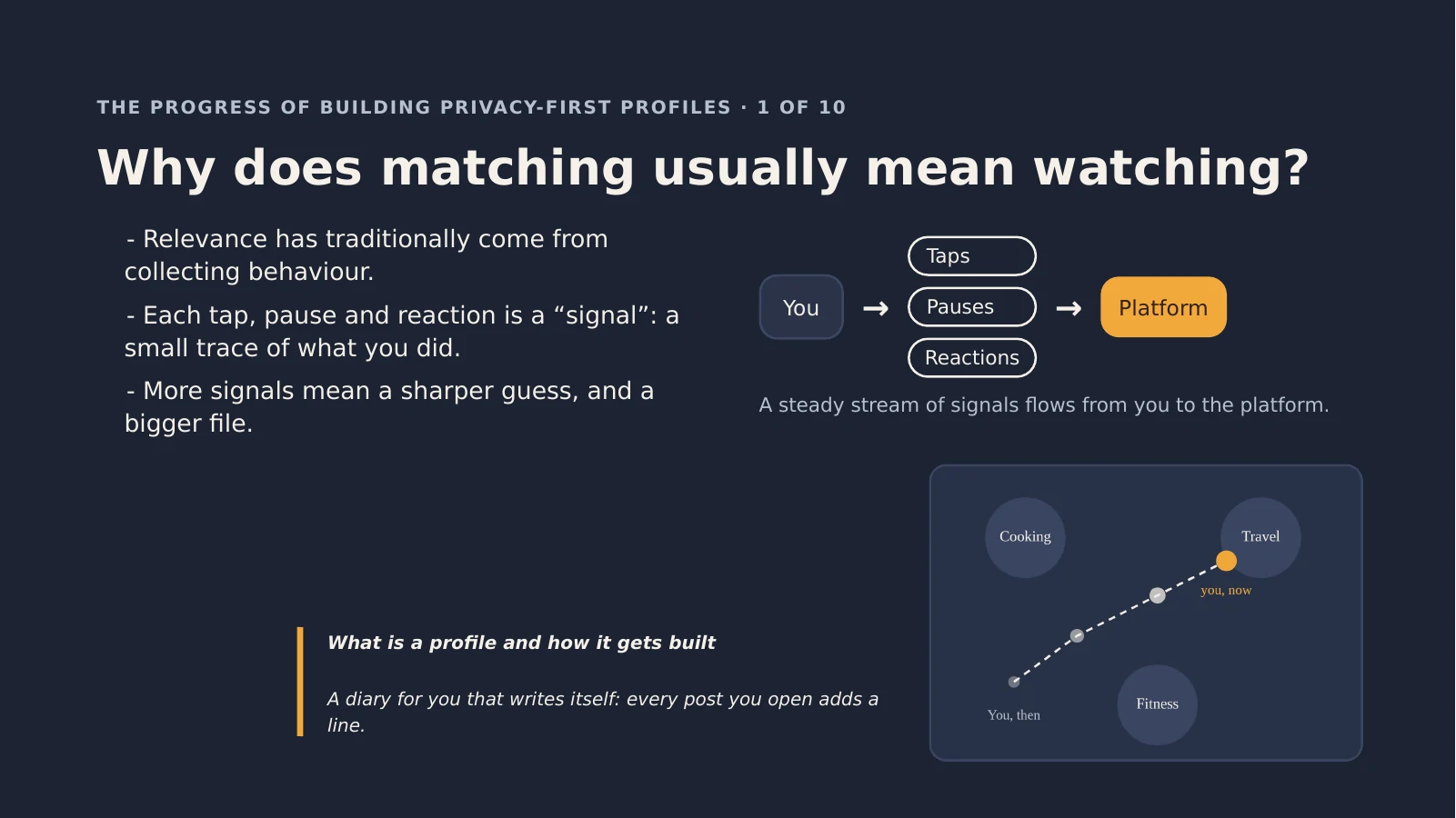
Matching has usually meant watching
Relevance has traditionally come from collecting behaviour. Every tap, pause and reaction is a signal, a small trace of something you did. More signals give a platform a sharper guess about you, and a bigger file on you.
That file is your profile. Think of it as a diary that writes itself: every post you open adds a line. You were reading about cooking in spring and about travel in summer, and the diary noticed.
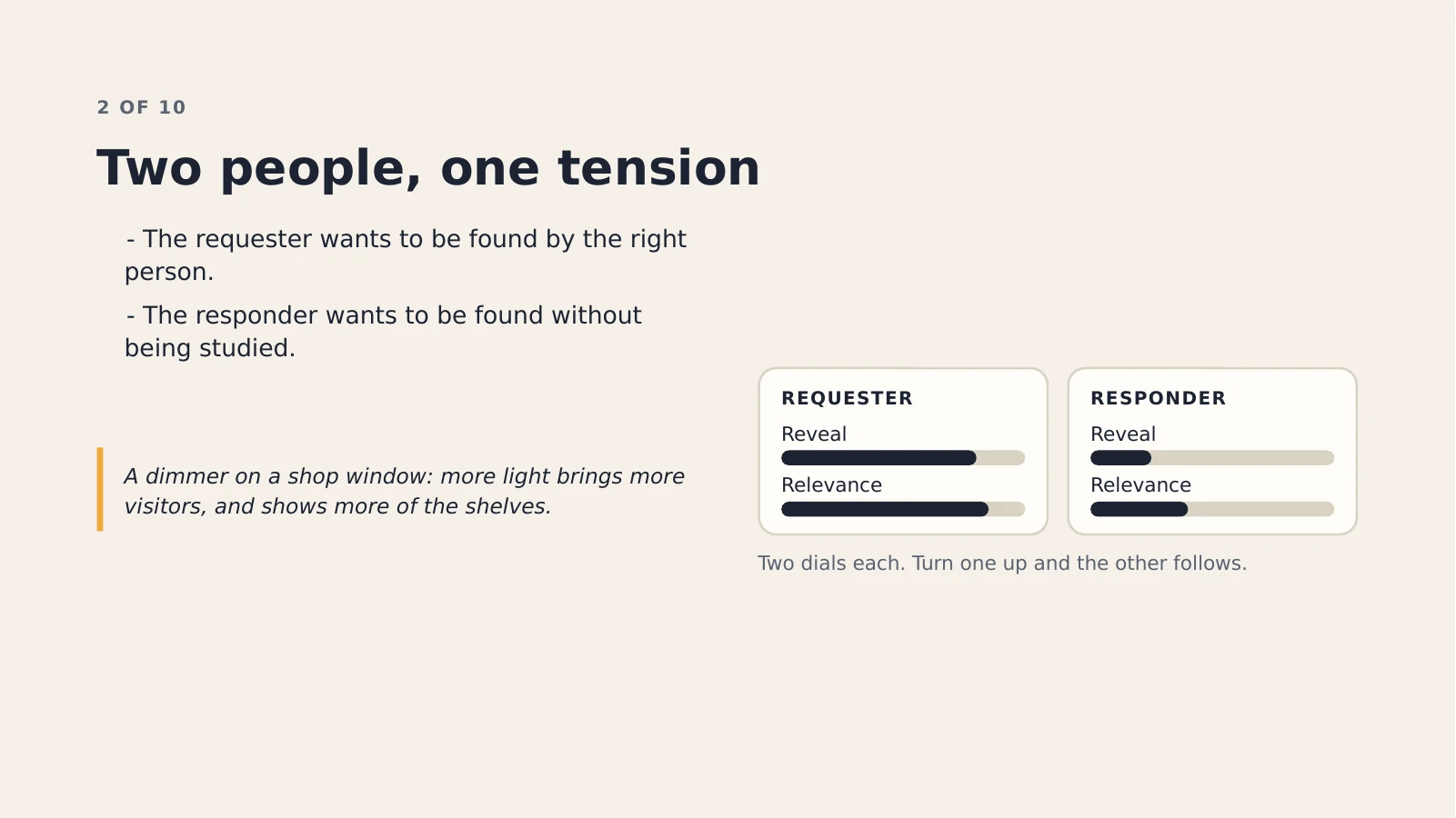
Matching also involves two people who want slightly different things. The one asking wants to be found by the right person. The one answering wants to be found without being studied. Picture a shop window with a dimmer: more light brings more visitors and also shows more of the shelves.
How matching works today: a map of meaning
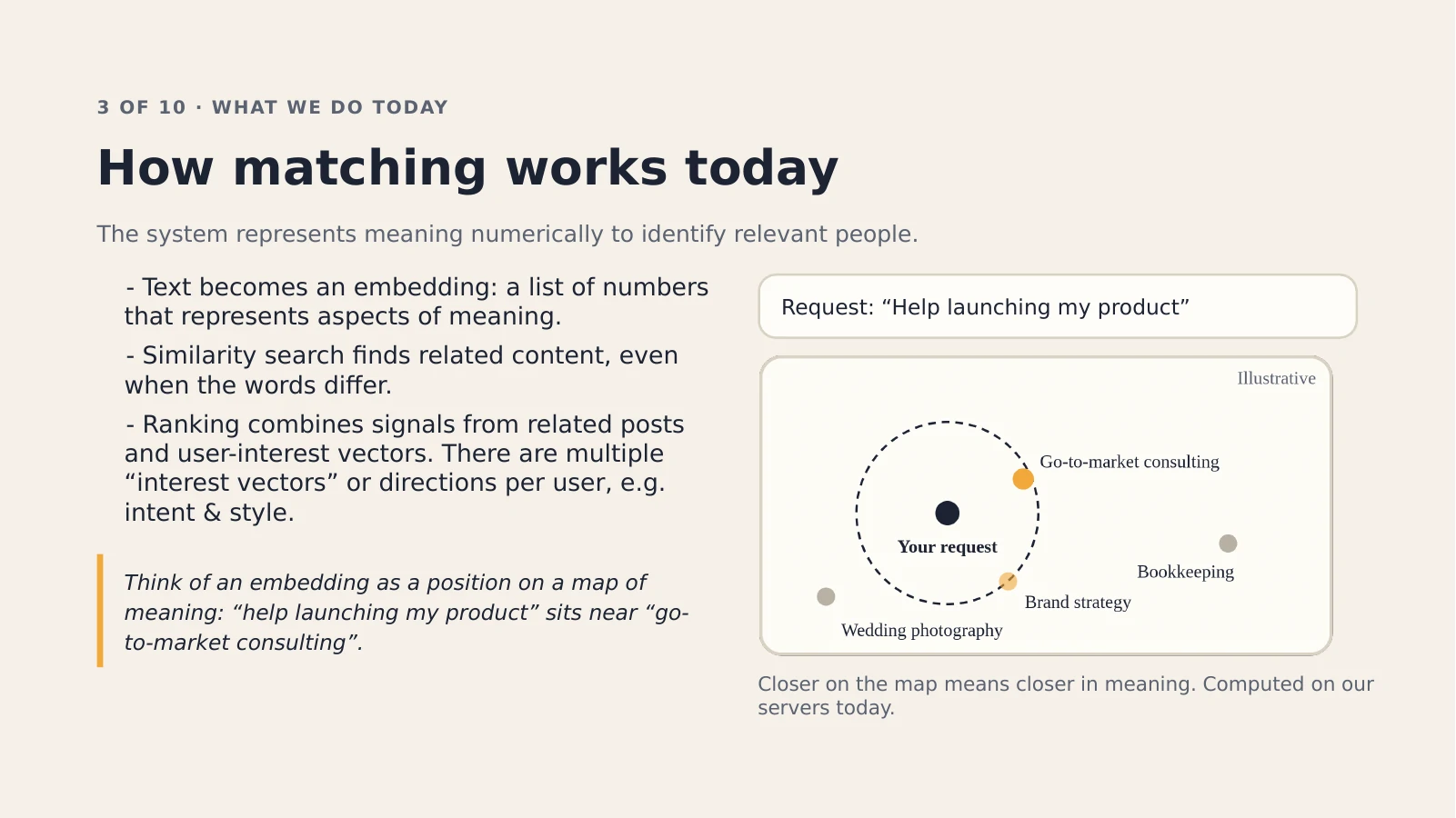
Modern matching rarely depends on identical words. A language model turns a piece of text into an embedding, a long list of numbers that captures aspects of its meaning.1 You can treat those numbers as coordinates on a map. “Help launching my product” lands close to “go-to-market consulting” and far from “wedding photography”, although the first two share no words.
Finding the nearest points on that map quickly, among very many, is called similarity search, and good open tools exist for it.2 LupaChoice combines the results with signals from related posts and with a few “interest directions” per person, for example what you intend to do and the style you prefer.
Today this happens on our servers, on numbers our servers can read. An embedding looks like gibberish to a human, but it is a description of your text. It is not encryption.
What encryption already does
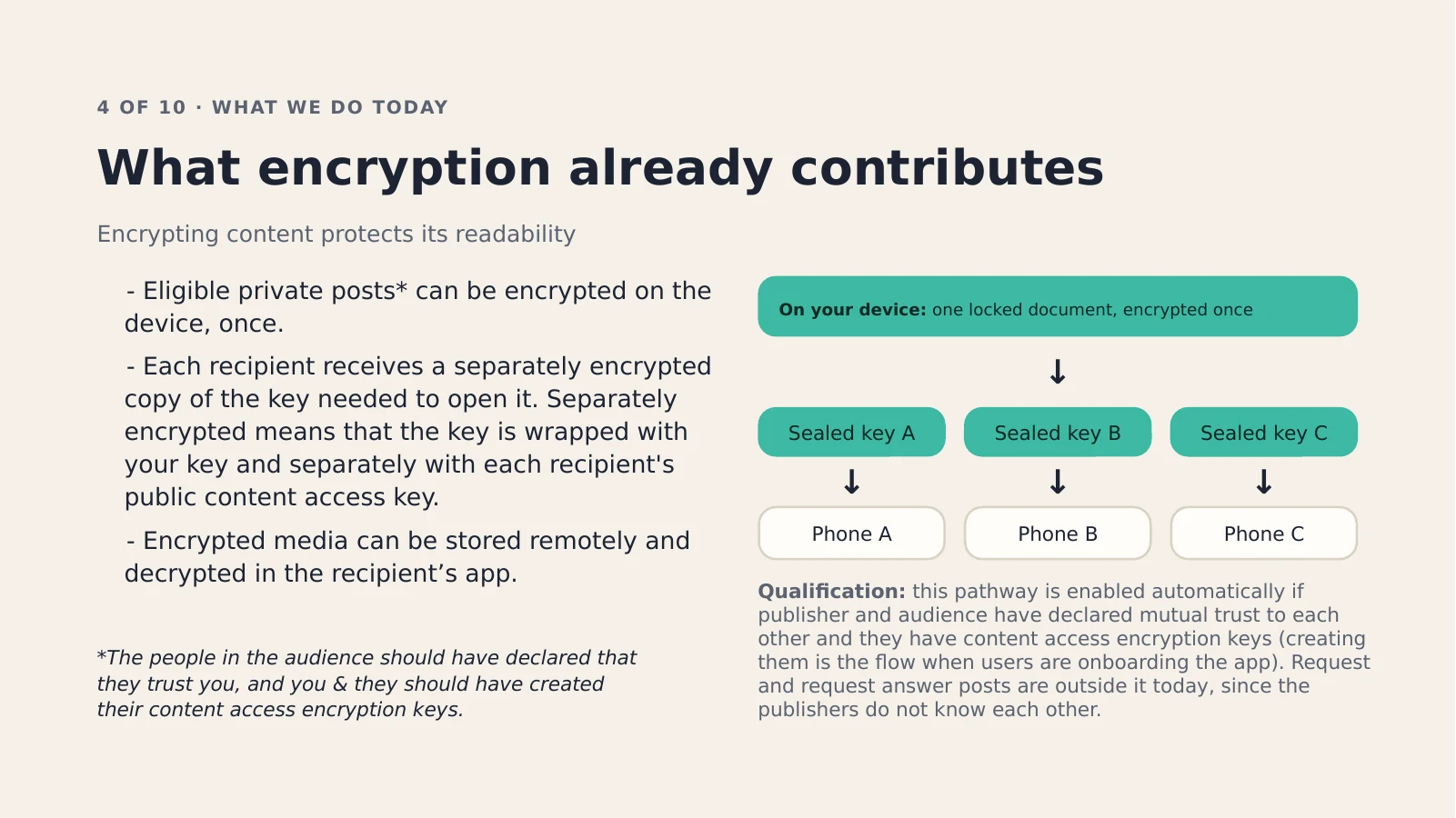
Some content in LupaChoice is already locked before it leaves your phone. It works like a locked box with several keyholders:
- Lock once. Your phone encrypts the post a single time.
- Seal a key for each reader. The key that opens it is wrapped separately for you and for every recipient, using each person’s public content-access key.
- Store the locked copy. The encrypted media can sit on a remote server. It is opened inside the recipient’s app.
This path has a condition. It switches on automatically when the author and the audience have declared that they trust each other, and all of them have created their keys during onboarding. Requests and answers to requests are outside it today, because they travel between people who do not know each other yet.
Private from whom?
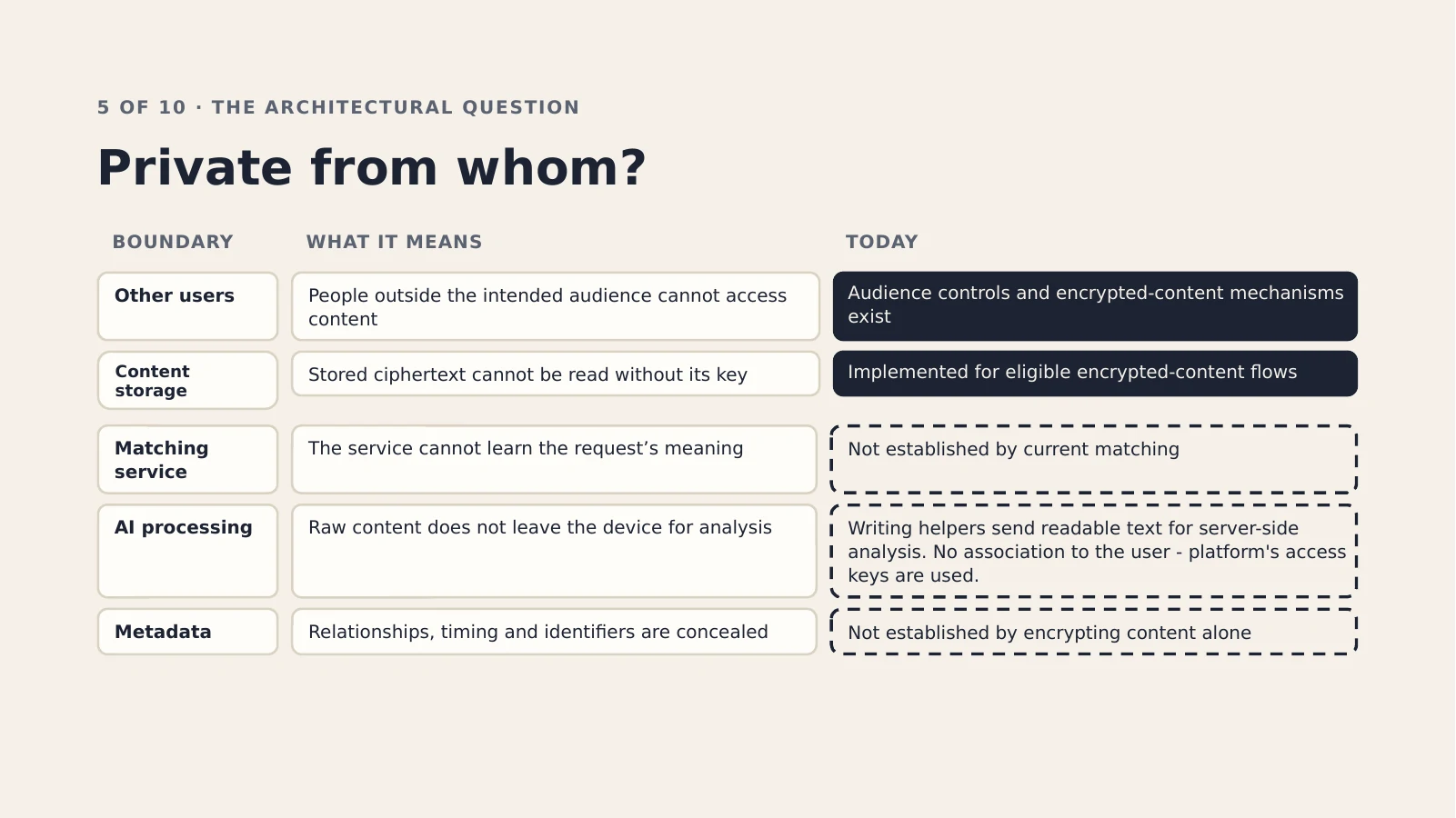
“Private” means little until you say who is being kept out. Here is where we stand on five different boundaries.
| Kept out of | What it would mean | Today |
|---|---|---|
| Other users | People outside the intended audience cannot access content | In place Audience controls and encrypted-content mechanisms |
| Content storage | Stored ciphertext cannot be read without its key | In place For eligible encrypted-content flows |
| Matching service | The service cannot learn what a request means | Not yet Current matching does not provide this |
| AI processing | Raw content does not leave the device for analysis | Not yet Writing helpers send readable text to be analysed on a server, under the platform’s own access keys, with no link to your identity |
| Metadata | Relationships, timing and identifiers are hidden | Not yet Encrypting content alone does not hide these |
A profile can be a fingerprint
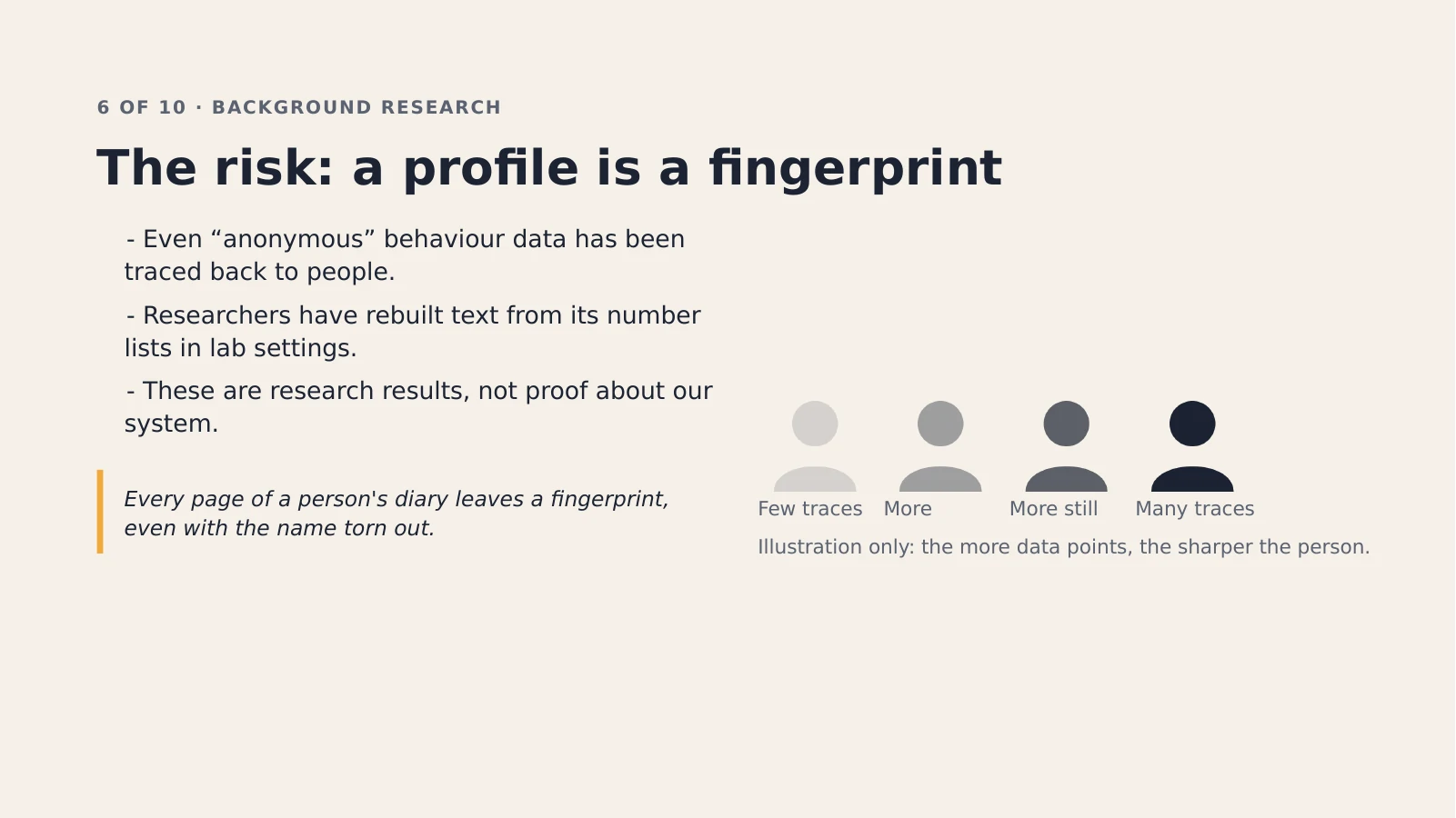
You might think removing names solves the problem. In 2006 Netflix published movie ratings from about 500,000 subscribers, without names, for a research competition. Two researchers showed that knowing eight of a person’s ratings, with dates that could be off by two weeks and two of the ratings completely wrong, was enough to single out 99% of records.3 They revisited the lesson ten years later.4
Embeddings carry a related risk. In a 2023 study, researchers rebuilt 92% of short text snippets word for word from their embeddings alone.5 The snippets were 32 tokens long, about the length of a sentence or two.
These are research results from particular datasets and models. They are not a test of our system. They do tell us what we should assume an attacker could try.
Others have shipped parts of the answer

Apple recognises landmarks in your photos with a private lookup. Your phone spots a region that may contain a landmark, turns it into an embedding and encrypts it. The server compares it with its index using homomorphic encryption, a technique that allows calculations on locked data. It is like working on an object inside a sealed glovebox you cannot see into. The answer comes back still locked, and only your phone can open it.11
Encryption is one layer of several there. The phone has to reveal which section of the index to search, so Apple adds decoy queries, differential privacy (more on that below) and a relay that hides your IP address.11
Signal tackled a different problem: telling you which of your contacts use the app without collecting your address book. Scrambling phone numbers with a hash is too weak, because there are few enough phone numbers to try them all. In 2017 Signal published a preview of another route, where the lookup runs inside a sealed area of the processor and your app can check which code is running there before sending anything.13 Here the trust rests partly on the hardware.
Each solves a well-defined lookup: a landmark in an index, a number in a list. Matching an open-ended request with a stranger who can help, and ranking the candidates well, is a wider problem.
Good engineering has to be understood too

Apple’s feature arrived switched on by default, and many people first heard of it from worried headlines.12 The writer Nick Heer judged it responsibly built in nearly every way, and still hard to trust, because it was enabled without asking and poorly explained.14
We take that as a design requirement. If people cannot understand what leaves their phone, strong mathematics will not earn their trust. It is one reason we are writing this.
Our direction: blur it before it leaves

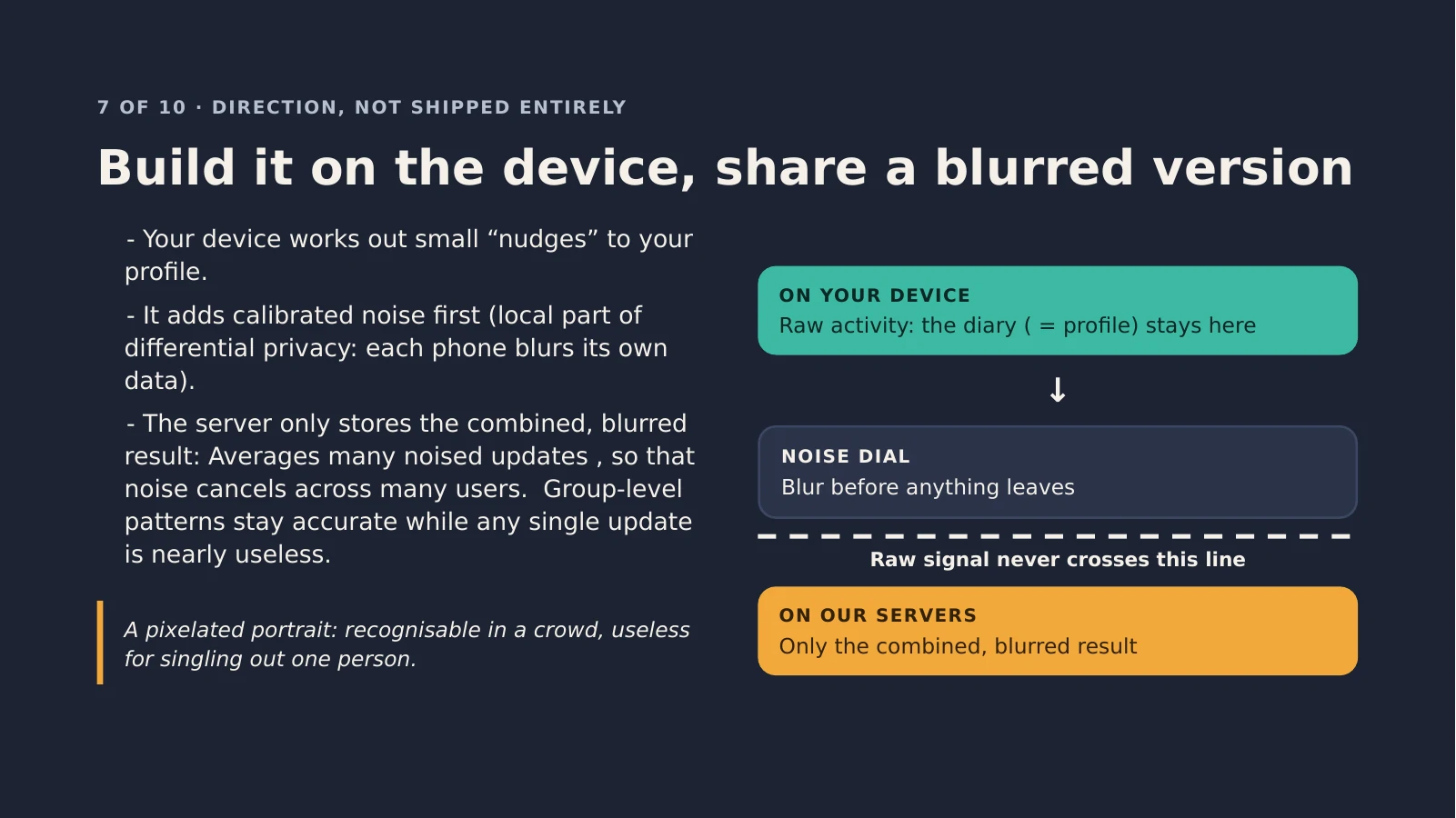
The idea we are building towards keeps the diary on your phone. This part is a direction, and it is not fully shipped.
- Your phone works out a small nudge to your profile from what you did.
- It adds random noise to that nudge before sending anything.
- Our servers average many noisy nudges and keep the combined result. Your raw activity stays on the device.
How can noisy data be useful? Try a classic thought experiment. You ask a thousand people an embarrassing yes-or-no question. Each one secretly flips a coin. Heads, they tell the truth. Tails, they flip again and answer “yes” for heads and “no” for tails.
This is the core of local differential privacy: each phone blurs its own data, the noise largely cancels across many users, and group patterns stay visible while one person’s report says very little. The theory is well established,6 Google and Apple have used versions of it to collect usage statistics,78 and a related line of work, federated learning, trains models while the training data stays on people’s devices.9
There is a catch. Every update leaks a little, even a noisy one, and the leaks add up over time. Differential privacy lets us measure that loss and cap it. The cap is called a privacy budget. Once you can put a number on it, you can also compare one method honestly with another.
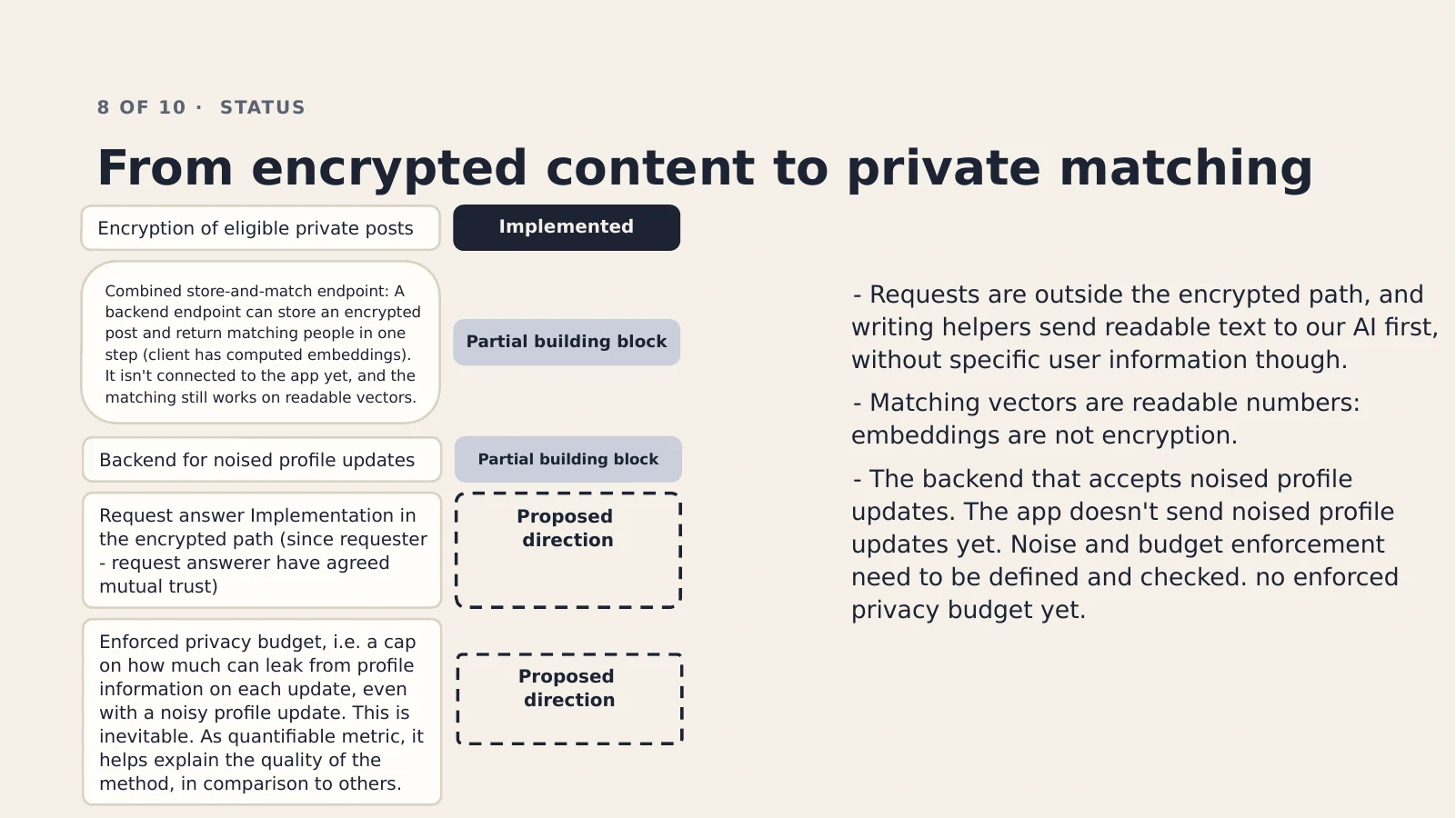
Where we are: built, partial, proposed
-
Implemented
Encryption of eligible private posts.
-
Partial building block
Store and match in one step. A backend endpoint can store an encrypted post and return matching people, using embeddings computed by the client. The app does not use it yet, and matching still works on readable vectors.
-
Partial building block
Noisy profile updates. The backend can accept them. The app does not send them yet, the noise and its checks still have to be defined, and no privacy budget is enforced.
-
Proposed
Answers to requests on the encrypted path, since by then the two people have agreed to trust each other.
-
Proposed
An enforced privacy budget that caps how much profile information can leak.
The hard parts
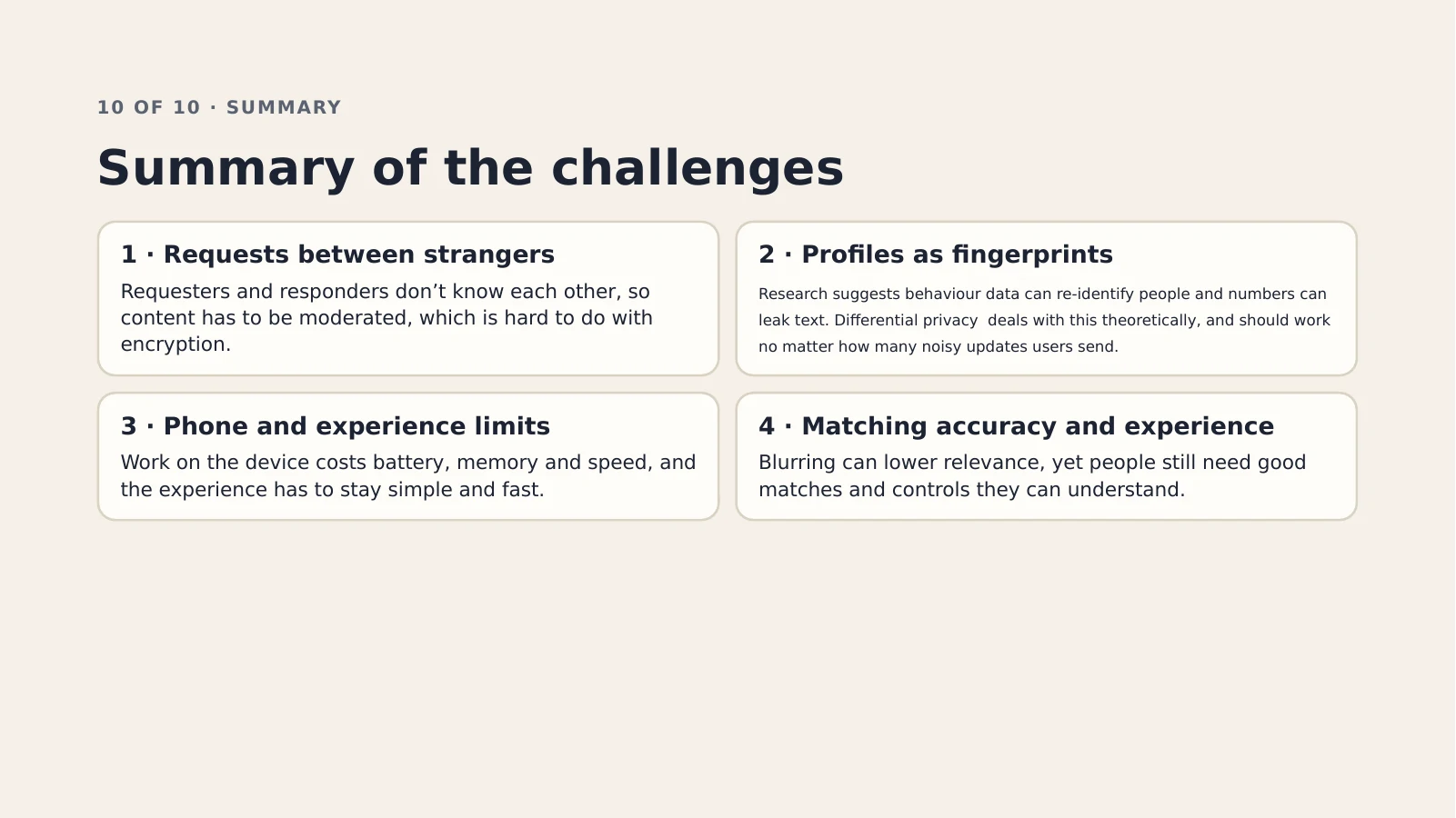
Requests between strangers
Content exchanged by people who do not know each other has to be moderated, and moderating what you cannot read is difficult.
Fingerprints that build up
Privacy protection has to hold after the thousandth noisy update as well as the first.
Phone limits
Work done on the device costs battery, memory and time, and the app has to stay quick and simple.
Match quality
Blur can lower relevance. People still need good matches, and controls they can understand.
Could we simply encrypt the whole search? Research shows it can be done, at a price. A system called Tiptoe searched 360 million web pages without its servers learning the query, using a 45-server cluster, about 57 MiB of traffic and 2.7 seconds per search. On a standard benchmark the best answer appeared around position 7.7 on average, compared with 2.3 for a leading non-private method.10 Those numbers are a fair picture of the trade-off: privacy, speed, cost and quality all pull on each other.
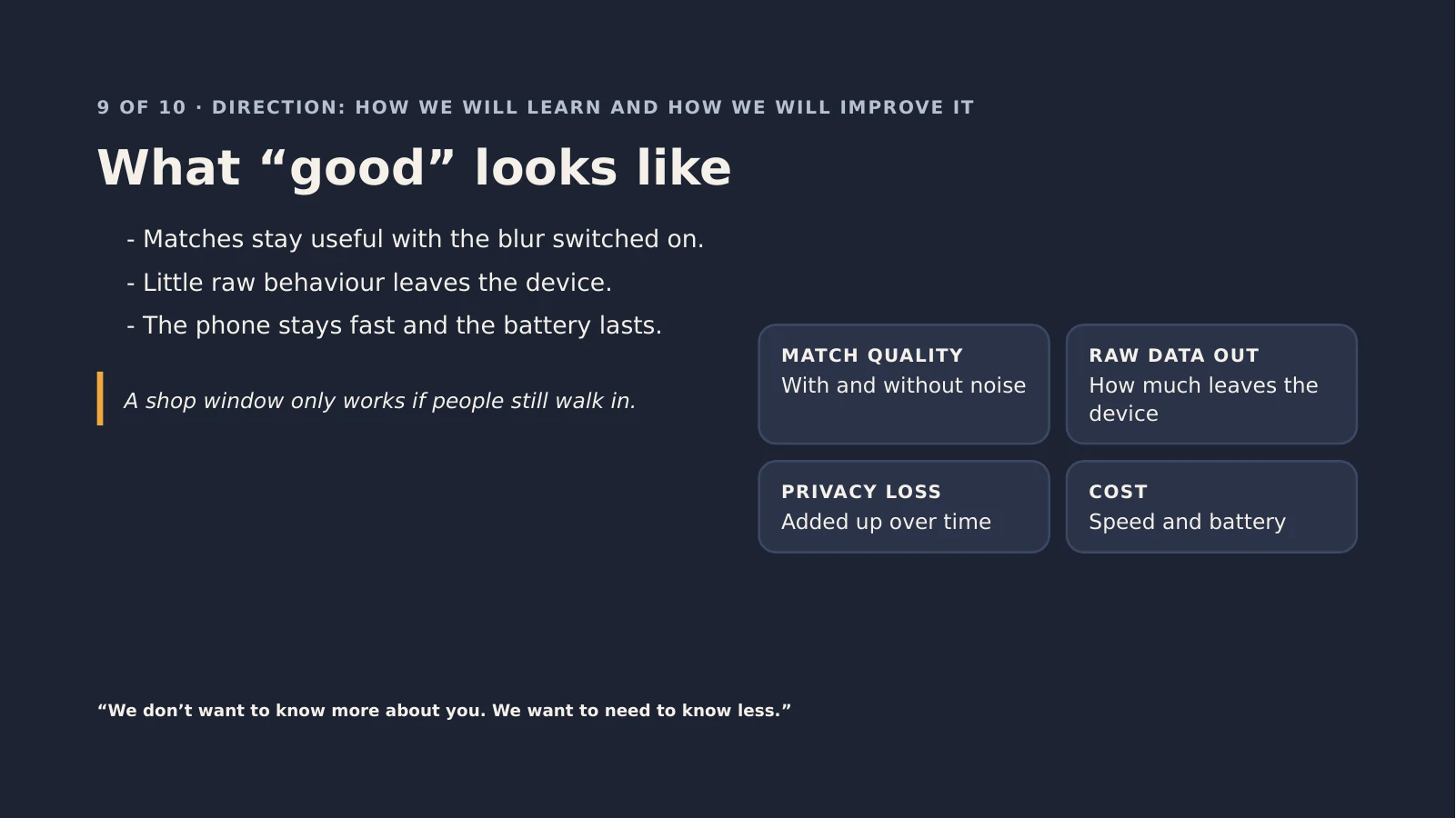
What “good” looks like
We will judge progress on four measurements:
Match quality
Compared with and without noise
Raw data out
How much leaves the device
Privacy loss
Added up over time
Cost
Speed and battery
The goal is a profile that makes you stand out to the right match and stay hard to single out in a crowd, even after a million updates.
We don’t want to know more about you. We want to need to know less.
Over to you
If you build privacy features at work, which hard engineering problem would you most like to crack? Tell us.
References
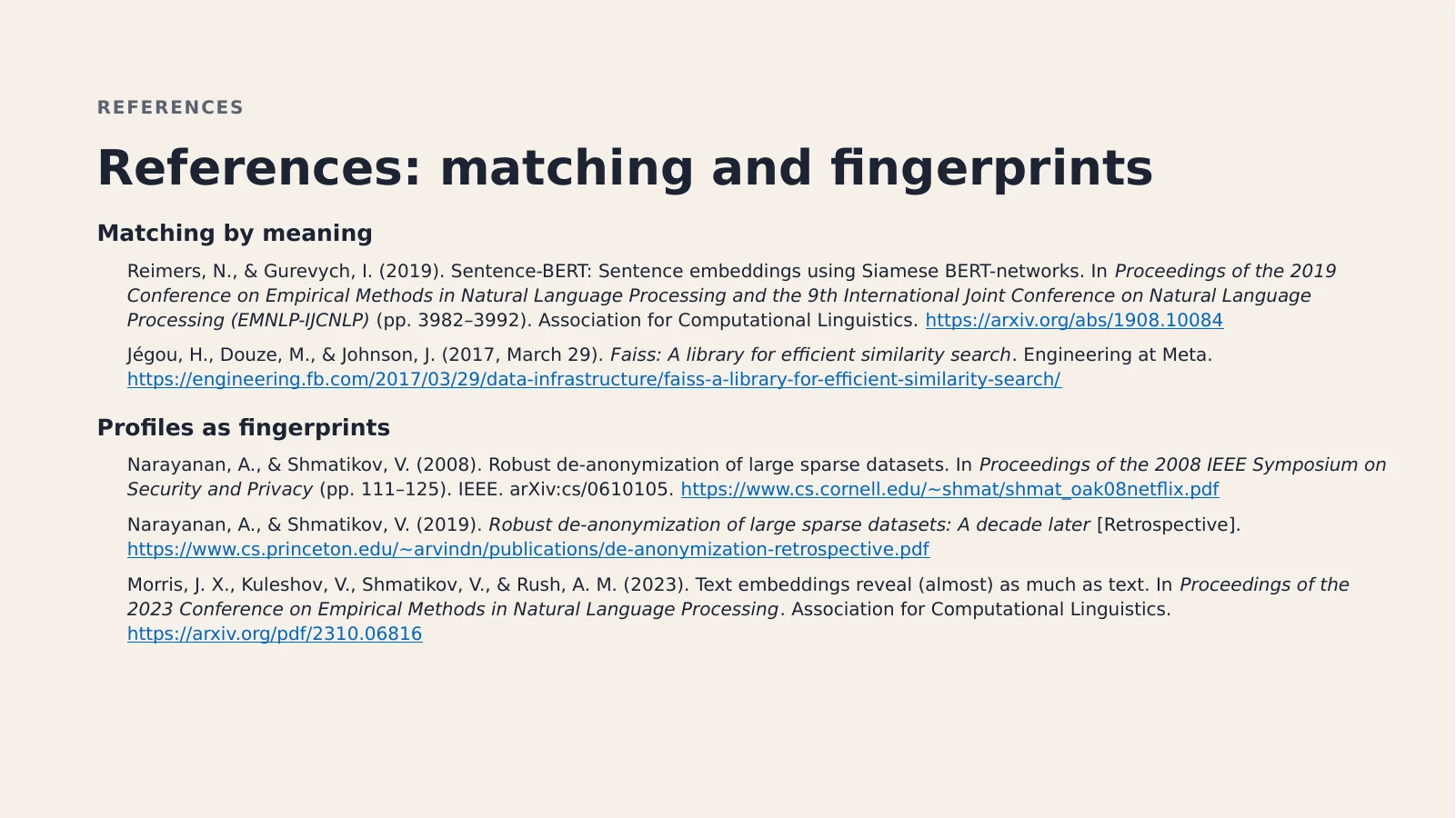
Matching by meaning
- Reimers, N., & Gurevych, I. (2019). Sentence-BERT: Sentence embeddings using Siamese BERT-networks. In Proceedings of the 2019 Conference on Empirical Methods in Natural Language Processing and the 9th International Joint Conference on Natural Language Processing (EMNLP-IJCNLP) (pp. 3982–3992). Association for Computational Linguistics. https://arxiv.org/abs/1908.10084
- Jégou, H., Douze, M., & Johnson, J. (2017, March 29). Faiss: A library for efficient similarity search. Engineering at Meta. https://engineering.fb.com/2017/03/29/data-infrastructure/faiss-a-library-for-efficient-similarity-search/
Profiles as fingerprints
- Narayanan, A., & Shmatikov, V. (2008). Robust de-anonymization of large sparse datasets. In Proceedings of the 2008 IEEE Symposium on Security and Privacy (pp. 111–125). IEEE. arXiv:cs/0610105. https://www.cs.cornell.edu/~shmat/shmat_oak08netflix.pdf
- Narayanan, A., & Shmatikov, V. (2019). Robust de-anonymization of large sparse datasets: A decade later [Retrospective]. https://www.cs.princeton.edu/~arvindn/publications/de-anonymization-retrospective.pdf
- Morris, J. X., Kuleshov, V., Shmatikov, V., & Rush, A. M. (2023). Text embeddings reveal (almost) as much as text. In Proceedings of the 2023 Conference on Empirical Methods in Natural Language Processing. Association for Computational Linguistics. https://arxiv.org/pdf/2310.06816
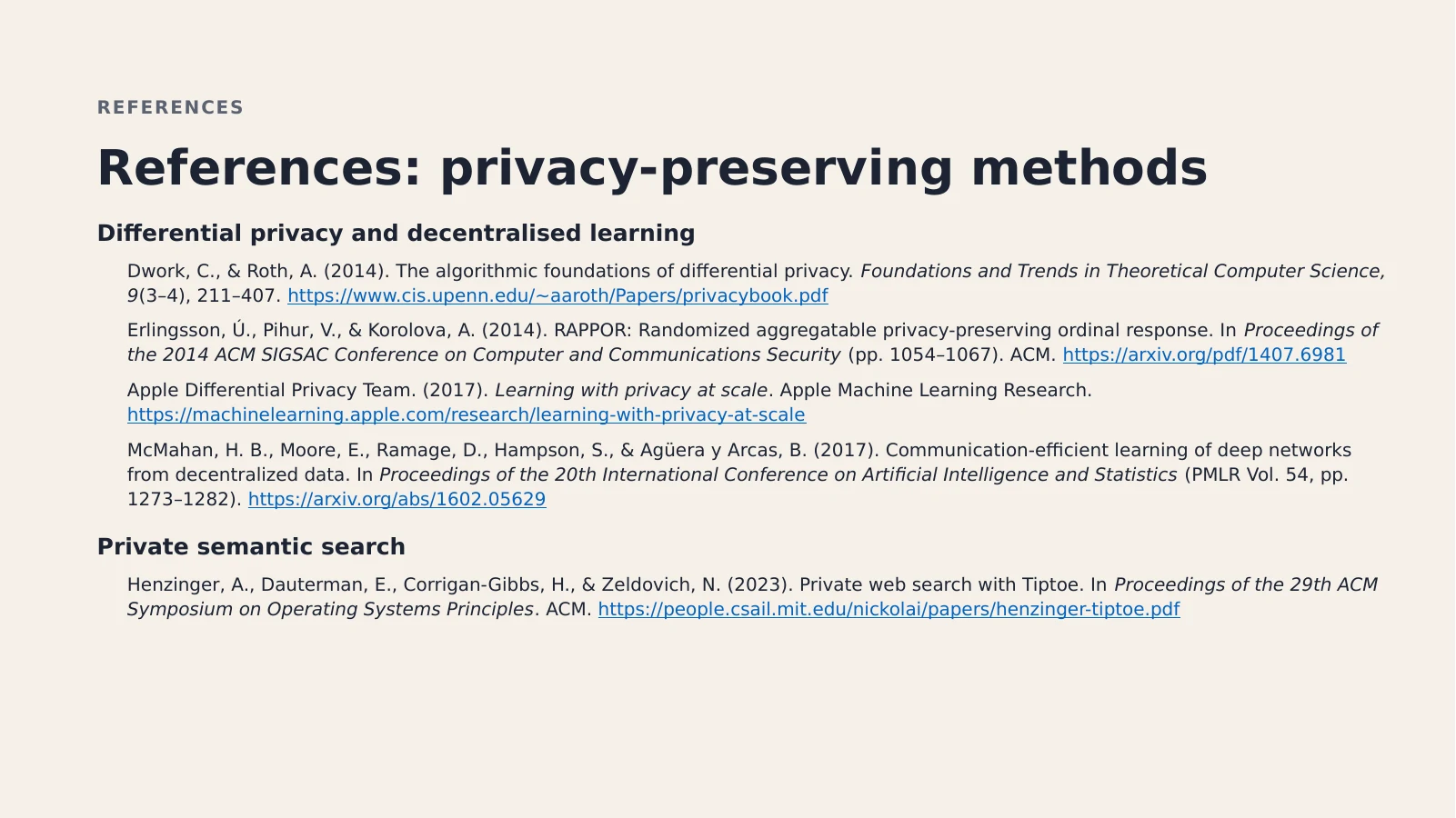
Differential privacy and decentralised learning
- Dwork, C., & Roth, A. (2014). The algorithmic foundations of differential privacy. Foundations and Trends in Theoretical Computer Science, 9(3–4), 211–407. https://www.cis.upenn.edu/~aaroth/Papers/privacybook.pdf
- Erlingsson, Ú., Pihur, V., & Korolova, A. (2014). RAPPOR: Randomized aggregatable privacy-preserving ordinal response. In Proceedings of the 2014 ACM SIGSAC Conference on Computer and Communications Security (pp. 1054–1067). ACM. https://arxiv.org/pdf/1407.6981
- Apple Differential Privacy Team. (2017). Learning with privacy at scale. Apple Machine Learning Research. https://machinelearning.apple.com/research/learning-with-privacy-at-scale
- McMahan, H. B., Moore, E., Ramage, D., Hampson, S., & Agüera y Arcas, B. (2017). Communication-efficient learning of deep networks from decentralized data. In Proceedings of the 20th International Conference on Artificial Intelligence and Statistics (PMLR Vol. 54, pp. 1273–1282). https://arxiv.org/abs/1602.05629
Private semantic search
- Henzinger, A., Dauterman, E., Corrigan-Gibbs, H., & Zeldovich, N. (2023). Private web search with Tiptoe. In Proceedings of the 29th ACM Symposium on Operating Systems Principles. ACM. https://people.csail.mit.edu/nickolai/papers/henzinger-tiptoe.pdf
Private discovery in shipped products
- Apple. (2024, October 24). Combining machine learning and homomorphic encryption in the Apple ecosystem. Apple Machine Learning Research. https://machinelearning.apple.com/research/homomorphic-encryption
- Miller, C. (2025, January 14). How Enhanced Visual Search on iPhone upgrades the Photos app and protects your privacy. 9to5Mac. https://9to5mac.com/2025/01/14/enhanced-visual-search-apple-privacy/
- Marlinspike, M. (2017, September 26). Technology preview: Private contact discovery for Signal. Signal Blog. https://signal.org/blog/private-contact-discovery/
- Heer, N. (2024, December 29). Apple Photos’ “Enhanced Visual Search” matches possible landmarks remotely. Pixel Envy. https://pxlnv.com/linklog/enhanced-visual-search/